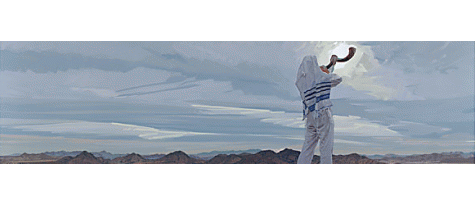
Hanukkah: The Feast of Dedication

Hanukkah
The Feast of Dedication
Festival of Lights

Hanukkah, Chanukah…

However you spell it! Hanukah is a transliteration for the Hebrew word which means “Dedication.”

What do you think of when you hear the word Hanukkah?
Some might say that it’s the Jewish “Christmas”…
For those who know a little bit more about Hanukkah…
…lighting candles, spinning dreidels, and eating greasy food.

There is much more to this feast of “Dedication” though. The dedication spoken of here is of the re-dedication of the Temple in Jerusalem. A historical event some say was prophesied by the Prophet Daniel.

Daniel describes what he sees in a vision in Daniel chapter eight, as a series of rams and goats and the horns on these animals. Near the end of the chapter a messenger of the Almighty named Gabriel is instructed to explain the meaning of the animals and their horns.

Daniel 8:20-25: You saw a ram with two horns which are the kings of Media and Persia. The shaggy male goat is the king of Greece, and the prominent horn between its eyes is the first king. As for the horn that broke and four which rose up in its place, four kingdoms will arise out of this nation, but not with the power the first king had. In the latter part of their reign, when the evildoers have become as evil as possible, there will arise an arrogant king skilled in intrigue. His power will be great, but not with the power the first king had. He will be amazingly destructive, he will succeed in whatever he does, and he will destroy the mighty and holy ones. He will succeed through craftiness and deceit, become swelled with pride, and destroy many people just when they feel the most secure. He will even challenge the prince of princes; but, without human intervention, he will be broken.
Aligning the prophecy with historical records, we find that the 2 kings of Medo-Persia were Darius the Mede and then Cyrus, who were conquered by Alexander the Goat… I mean Great, as was most of the known world of the ancient Greeks.

Daniel 8:5-7: I was beginning to understand, when a male goat came from the west, passing over the whole earth without touching the ground. The goat had a prominent horn between its eyes. It approached the ram with the two horns, which I had seen standing in front of the river, and charged it with savage force. I watched as it advanced on the ram, filled with rage against it, and struck the ram, breaking its two horns. The ram was powerless to stand against it. It threw the ram to the ground and trampled it down, and there was no one that could rescue it from the goat’s power.

Alexander the Great’s rule didn’t last very long. He was only 32 when he fell ill, and his kingdom was divided into 4 major portions, between 4 of his generals: Cassander in Macedon, Lysimachus in Thrace, Seleucus in Mesopotamia, and Ptolemy in Levant and Egypt.

Daniel 8:8: The male goat then became extremely strong; but when it was strong, the big horn was broken; and in its place arose what appeared to be four horns in the directions of the four winds of heaven.
Anitochus IV lived from 215-163 BC and was ruler of the Seleucid Empire from 175-163 BC. He called himself Anitochus Epiphanes, exalting himself as god, Epiphanes meaning “The Shining One.”

Daniel 8:9-12: Out of one of them came a little horn which grew extremely big in the directions of the south and east, and in the direction of the Glory (Jerusalem). It grew so great that it reached the army of heaven; it hurled some of the army and the stars to the ground and trampled on them. Yes, it even considered itself as great as the prince of the army; the regular burnt offering was taken away from him, and the place of his sanctuary was thrown down. Through sin, the army was put in its power, along with the regular burnt offering. It flung truth on the ground as it acted and prospered.
Antiochus was different from other Greek rulers as they prospered and conquered the known world of the ancient Greeks. They all brought with them Greek thought and philosophy, and the many gods of Greek Mythology, but Antiochus seemed to have something out for the Jews. He had declared himself to be one of the gods, and this went against the very core of the Jewish people. Antiochus forced assimilation to the Greek way on everyone, and some Jewish people did give in to his “convert or die” mentality.
Laws and decrees were made against the Jewish people. They were forbidden to circumcise their children, and those who did anyway were killed; the child the mother and the one who performed the circumcision. Other laws were passed such as; you must eat pork, sacrificing to pagan gods, and forsaking the Sabbath. There was a rule that a Jewish bride would give the local ruler “first night privileges” before she could be with her groom.
As if all of this was not enough, Antiochus stopped the regular daily sacrificing at the Temple in Jerusalem and he desecrated the Temple by erecting a statue of himself there and sacrificing a hog on the alter in the Temple.

Daniel 8:13-14: Then I heard a holy one speaking, and another holy one said to the speaker, “How long will the events of the vision last, this vision concerning the regular offering and the transgression which is so appalling, that allows the sanctuary and the army to be trampled underfoot?” The first said to me, “Two thousand three hundred evenings and mornings, after which the sanctuary will be restored to its rightful state.”
This passage of Scripture is often misinterpreted. Two thousand three hundred evenings and mornings is often interpreted to be 2300 days, and that somehow prophetically means 2300 years. This interpretation ignores the subject of the question. The question is “How long will the events of the vision last, this vision concerning the regular offering.” The answer is “Two thousand three hundred evenings and mornings.” That’s 2300 evening and morning sacrifices.

Exodus 29:38: “Now this is what you are to offer on the altar: two lambs a year old, regularly, every day. The one lamb you are to offer in the morning and the other lamb at dusk. With the one lamb offer two quarts of finely ground flour mixed with one quart of oil from pressed olives; along with one quart of wine as a drink offering. The other lamb you are to offer at dusk; do with it as with the morning grain and drink offerings — it will be a pleasing aroma, an offering made to the LORD by fire. Through all your generation this is to be the regular burnt offering at the entrance to the tent of meeting before the LORD.
There was one evening and one morning regular offering everyday. This equals 1150 days, just over 3 years.
We don’t have the exact date for the day that Antiochus put an end to the regular offering, but on the 15th day of the 9th month of the Hebrew calender in the year 168 BC, Antiochus had a pagan idol erected in the Temple. On the 25th day of that same month hogs were offered on the alter to pagan gods, this would have certainly put an end to the regular sacrificing.

The end of the regular offering was to last 2300 evening and morning sacrifices. Three years later, from the day the hogs were sacrificed on the alter, or as the King James Version puts it the “transgression of desolation,” a band of militant priests known as the Maccabees lead a small army and regained control of Jerusalem and rededicated the Temple on the 25th day of the 9th month in the year 165 BC.

Daniel 8:26: The vision of the evenings and mornings which has been told is true; but you are to keep the vision secret, because it is about days in the distant future.
Gabriel informed Daniel that the vision of the regular sacrifice would be restored after the 3 year period, but that the vision was to be kept secret, “because it is about days in the distant future.” This is why the Messiah, when he spoke of the transgression or the abomination of desolation, he spoke of it as if it were still to come.

Matthew 24:15-16: “So when you see the abomination of desolation spoken about through the prophet Daniel standing in the Holy Place” (let the reader understand the allusion), “that will be the time for those in Judah to escape to the hills.
A ruler has already come forcing the way of the pagans onto those who wish to live by the Scriptures of the Almighty, making it illegal to honor God in the ways that He has commanded. Gabriel told Daniel it would happen concerning the 2300 regular offerings, but that it would also happen again later “in the distant future.” The Messiah reaffirms this Truth in Matthew 24:15-16.
The book of Maccabees is a historical document that relates the event that Daniel prophesied.
So what does lighting candles, and spinning dreidels and eating greasy food have to do with any of this?

Hanukkah being called the Festival of Lights, and the lighting of candles has much to do with one of the significant miracles of the historic event.
When the Maccabees regained control of Jerusalem, they immediately began to rebuild and clean the Temple that has been desecrated by the blood of pagan offerings. They made a new Menorah for the Temple as the old one had been stolen some 3 years prior. They found that there was only enough of the special olive oil to light the lamp for one day, though the light was supposed to stay lit continually. It would take eight days to press new oil and prepare it for the lamp.
They had a dilemma on there hands, to light the lamp in keeping with the command, or to wait until they had enough oil to keep the lamp lit continually, in keeping with that command.
The decision was made that they had a command that they were able to keep, so they should keep it. They used the one day flask of oil and lit the lamp and it miraculously stayed lit until the new oil was made for the Temple Menorah.

From this comes the tradition of fashioning a menorah to represent the miracle of the light, often called a Hanukkiyah. The Temple Menorah has three lights on either side of a central light called the Shamish (servant), totaling seven lights. The Hanukkiyah has a total of nine lights representing the eight night miracle and the ninth being the Shamish which lights the other lights.
The Dreidel game is a fun time to spend with family and friends playing for the riches of chocolate coins called gelt, Yiddish for money. The Dreidel is a like a top that you spin, it has 4 sides each with a Hebrew letter on it. The letter that is facing up corresponds to the action the player must take:
• Nun stands for nisht or “not”- nothing happens and the next player spins
• Gimel stands for gants or “all” - the player takes the whole pot
• Hey stands for halb or “half” - the player gets half of the pot
• Shin stands for Shtel ayn or “put in” - the player puts a coin in the pot
The letters on the Dreidel are an acronym for the phrase “Nes Gadol Haya Sham,” “A Great Miracle Happened There.” In the Land of Israel they replace the Shin with the letter Pe, to change the acronym to ” A Great Miracle Happened Here.”

Legend has it that while the Jews were being oppressed by the Greeks they used a similar gambling game as a diversion. They would have the children play the game and the oppressors would see that they were having a bad influence on the children; meanwhile the adults would hide and study their illegal copies of the Word of God the Torah.
The greasy food is another way to commemorate the miracle of the oil. Latkes (potato pancakes) and Sufganiyot (jelly dougnuts) are some of the favorite traditional foods.
Hanukkah is sometimes thought of by those that don’t really know the real story behind it, as the Jewish “Christmas.” This actually couldn’t be any further from the truth.
The actual event as described in the prophecy of Daniel, played out by the Maccabees, was one of Anti-Assimilation. It’s a story with many heroes, and miracles that they were blessed with by the Almighty God. These heroes stood for Truth, for Torah! They stood for keeping the commands of the Almighty God, and against compromising their beliefs by acting like the pagans that surrounded them. Even under harsh persecution they didn’t take on the ways of the heathen, not even if their lives depended on it.
Christmas however is about Assimilation. The christians over the ages have adapted every conceivable tradition from the pagans, and have tried to adapt some sort of theology to these traditions to make it ok to have assimilated.

God wants us to be Dedicated to His Word, to His Torah.
To call Hanukkah the Jewish Christmas is dishonoring to those that stood up for the Torah and lost their lives.
Hanukkah is about Dedication, Dedication to God. Dedication in a time when it is most difficult to be Dedicated.
Hanukkah is not one of the Moadim listed in Leviticus 23, but… Leviticus 24:1-4 says

The LORD said to Moses, “Order the people of Isra’el to bring you pure oil from crushed olives for the light, to keep lamps burning always. Outside the curtain of the testimony in the tent of meeting, Aaron is to arrange for the light to be kept burning always from evening until morning before the LORD; this is to be a permanent regulation through all your generations. He is always to keep in order the lamps on the pure Menorah before the LORD.
And finally, Messiah kept the Feast of Dedication…
John 10:22-23: And it was the Feast of Dedication at Jerusalem: it was winter; and Jesus was walking in the Temple in Solomon’s Porch
This for me is enough to know that I should learn about the Feast of Dedication. The Messiah did it! Lots of people are not afraid to ask the question, “what would Jesus do?”
More people need to not be afraid to Do What Y’shua/Jesus Did!
The Almighty YHVH’s blessings to you all…
May He grant you the wisdom, the power, and the peace to not Assimilate!!